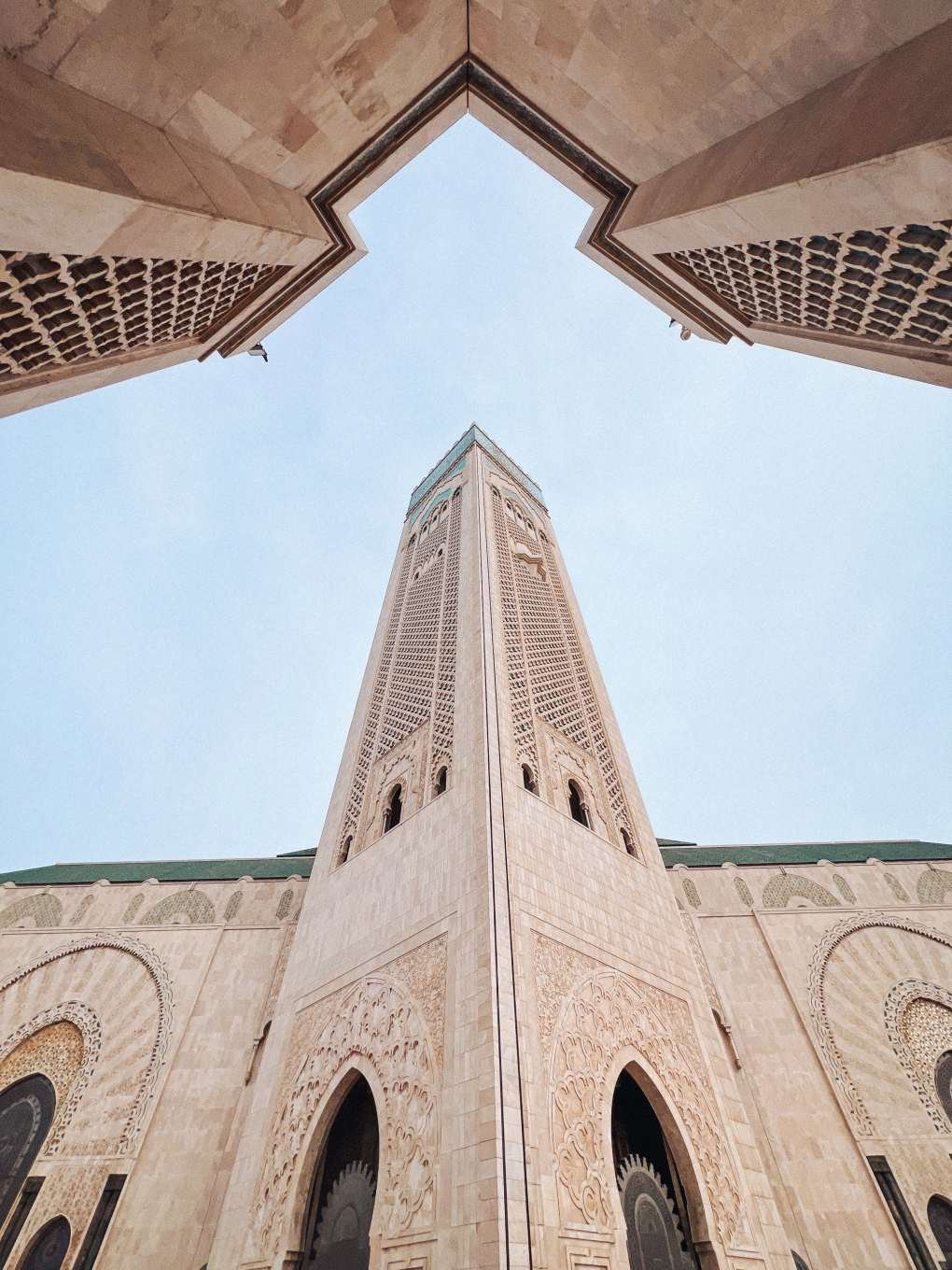
Al-Azhar Mosque (الجامع الأزهر) stands in the heart of historic Cairo and has been a place of prayer and learning for more than a thousand years. It is one of the oldest institutions of education in the world still in operation, and for many Muslims the word “Azhari” has become a synonym for a properly trained scholar or Quran teacher.
A Fatimid foundation
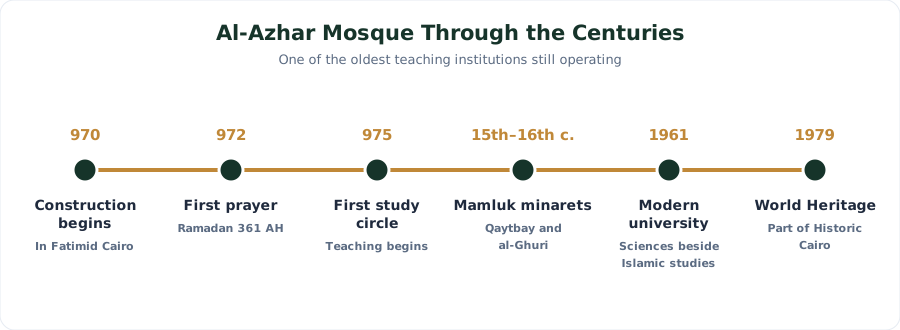
The mosque was built by the general Jawhar al-Siqilli for the Fatimid caliph al-Mu‘izz shortly after the founding of Cairo. Construction began in 970, and the first Friday prayer was held in 972 (Ramadan 361 AH). Its name, “the most radiant”, is often linked to Fatimah al-Zahra’, the Prophet’s daughter. In 975 the first study circle was held in its courtyard, and within a few years scholars were being paid to teach there — the beginning of a university long before the word existed in Europe.
From Fatimid to Sunni
When Salah al-Din (Saladin) ended Fatimid rule in 1171, the Friday prayer at al-Azhar was suspended for about a century. It was restored under the Mamluk sultan Baybars in the 1260s, and from then on al-Azhar became the leading centre of Sunni learning, teaching the four schools of law side by side. The Mamluks added colleges and minarets: the minaret of Qaytbay (1483) and the distinctive double-headed minaret of al-Ghuri (early 16th century) still define its skyline.
A meeting place of the Muslim world
For centuries students arrived from West Africa, the Maghreb, Turkey, Central Asia and Southeast Asia and lived in riwāqs — lodgings grouped by region — around the mosque. The office of the Grand Imam (Shaykh al-Azhar) has existed since the late 17th century. In 1961 a law reorganised al-Azhar University and added faculties such as medicine and engineering beside Islamic studies and Arabic. Today it welcomes students from more than a hundred countries, and Historic Cairo, with al-Azhar at its centre, has been a UNESCO World Heritage Site since 1979.
What is taught there
The traditional Azhari path combines memorisation and recitation of the Quran with tajwīd, Arabic grammar, jurisprudence, hadith and creed. A hallmark is the ijāzah and sanad: a certified chain of teachers going back, in Quran recitation, to the Prophet ﷺ himself.
Visiting al-Azhar
- Location: al-Azhar Street in Islamic Cairo, opposite the al-Hussein Mosque and a few minutes’ walk from the Khan el-Khalili bazaar.
- Entry: free; visitors are welcome outside the prayer times.
- Dress: modest clothing covering arms and legs; women cover their hair. Shoes are removed before entering the prayer area.
- Tip: visit in the late afternoon, when the marble courtyard is cooler and the light on the minarets is softest.
Learning the Azhari way, wherever you live
Most people who admire al-Azhar will never study in Cairo. The tradition, however, travels with its teachers. Our academy, Azhareon, is an independent academy — not an official part of al-Azhar — whose teachers are Azhari graduates teaching Quran, tajwīd and Arabic online, one to one, in the method they received. A free trial lesson is the simplest way to see what that means for you or your child.