Hajj is the pilgrimage to Makkah, the fifth pillar of Islam. Every adult Muslim who is physically and financially able must perform it once in a lifetime: “Pilgrimage to the House is a duty owed to God by all people who are able to make their way there” (Quran 3:97). Each year more than two million people from every country gather for it in the same few days.
Hajj retraces the steps of the Prophet Ibrahim (Abraham), his wife Hajar and their son Isma‘il, and it was completed in its present form by the Prophet Muhammad ﷺ in his Farewell Pilgrimage.
Who must perform it
The conditions are: being Muslim, adult and sane, and having the ability — good enough health, the means to travel and return, and provision for one’s dependants while away. Scholars add that a woman should travel with a mahram or, in the view of several schools, in a secure group. Whoever is unable is not obliged.
The days of Hajj, step by step
Before the 8th — Ihram. At the boundary stations (mīqāt) the pilgrim enters the sacred state of iḥrām: men wear two plain white cloths, women their ordinary modest clothing, and everyone repeats the Talbiyah: “Labbayka Llāhumma labbayk — Here I am, O God, here I am.”
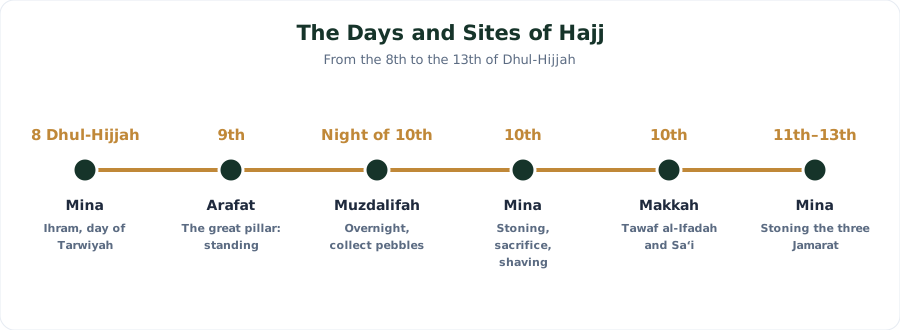
8th Dhul-Hijjah — Mina. Pilgrims go to the tent city of Mina and pray there.
9th — Arafat. The heart of Hajj. From noon until sunset pilgrims stand on the plain of Arafat in prayer and supplication. The Prophet ﷺ said: “Hajj is Arafah.” Missing this day means missing the Hajj.
Night of the 10th — Muzdalifah. After sunset they move to Muzdalifah, pray, rest under the open sky and gather small pebbles.
10th — Eid al-Adha. Back in Mina, pilgrims throw seven pebbles at the large pillar (Jamrat al-‘Aqabah), offer an animal sacrifice, and men shave or shorten their hair (women cut a fingertip’s length). They then go to Makkah for the Tawaf al-Ifadah around the Kaaba and the Sa‘i between Safa and Marwah.
11th–13th — the days of Tashriq. Pilgrims stay in Mina and stone the three pillars each day. Before leaving Makkah they perform the farewell Tawaf.
Pillars and obligations
According to the majority of scholars, the pillars without which Hajj is invalid are four: Ihram, standing at Arafat, Tawaf al-Ifadah and Sa‘i (the Hanafi school counts Sa‘i as an obligation rather than a pillar). Other acts, such as staying at Muzdalifah and stoning, are obligations that are compensated by a sacrifice if omitted.
Hajj and Umrah
Umrah, the “lesser pilgrimage”, consists of Ihram, Tawaf, Sa‘i and cutting the hair, and can be done at any time of the year. Hajj happens only on these fixed days and includes Arafat, Muzdalifah and Mina. Most pilgrims combine the two.
Preparing well
Many pilgrims say what they regret most is not having learned the supplications and the Talbiyah beforehand, so that they spent Arafat reading from a booklet instead of speaking from the heart. Learning the Arabic words, their meaning and their pronunciation in the months before departure — with a teacher who can explain them — turns the journey into something you understand at every step.