
Ruku (رُكوع) is the bowing position in the Muslim prayer. It comes after the recitation while standing and before the prostrations, and it is one of the pillars (arkān) of the prayer: a unit performed without it is not counted. The Quran names it alongside prostration: “O you who believe, bow and prostrate, and worship your Lord” (22:77).
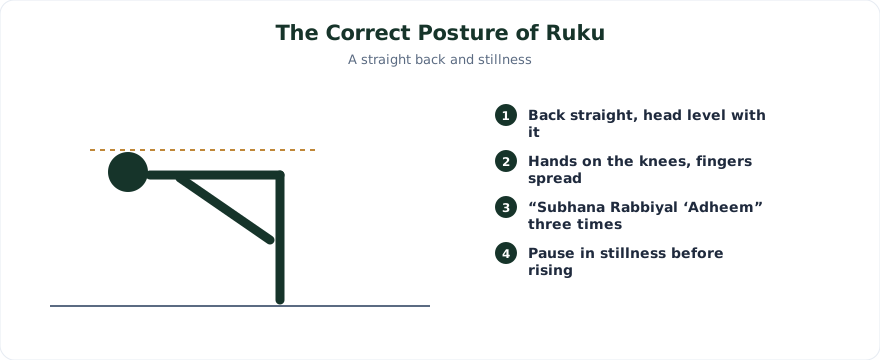
The correct posture
- Bend at the hips until your back is straight and roughly parallel to the floor.
- Keep the head level with the back — neither raised nor hanging down.
- Place both palms on the knees, fingers spread and gripping them.
- Keep the arms slightly away from the sides (for men); the legs stay straight without locking stiffly.
A companion described the Prophet’s ﷺ bow: his back was so level that if water had been poured on it, it would have stayed in place.
What is said
On bowing, the worshipper says “Allahu akbar”, and in the bow repeats “Subḥāna Rabbiya l-‘Aẓīm” — “Glory be to my Lord, the Most Great” — at least once, ideally three times. Rising, he says “Sami‘a Llāhu li-man ḥamidah” (God hears the one who praises Him) and then, upright, “Rabbanā wa laka l-ḥamd” (Our Lord, and to You belongs all praise).
Stillness: the part most people skip
The scholars stress ṭuma’nīnah: remaining still in the bow until the body has settled, then rising fully upright before going down to prostrate. In a well-known hadith, a man prayed quickly and the Prophet ﷺ told him three times, “Go back and pray, for you have not prayed,” then taught him to bow until he was at rest. Rushing the bow is therefore not a matter of style — it affects the validity of the prayer.
Common mistakes
- A rounded back with the head dropped below the shoulders.
- Bending only slightly, so the hands barely reach the thighs.
- Rising halfway and going straight down to prostration.
- Mumbling the words so fast that the Arabic is lost.
Joining a congregation late
According to the majority of scholars, if you join the imam while he is still in ruku and you bow with him before he rises, you have caught that unit. If he has already risen, you follow him but make up the unit at the end.
Learning it properly
The movement itself is learned in minutes; what takes practice is pronouncing the words clearly and keeping the stillness. In a live lesson a teacher can watch your posture and listen to your Arabic at the same time — the quickest way for a new Muslim or a child to pray with confidence.