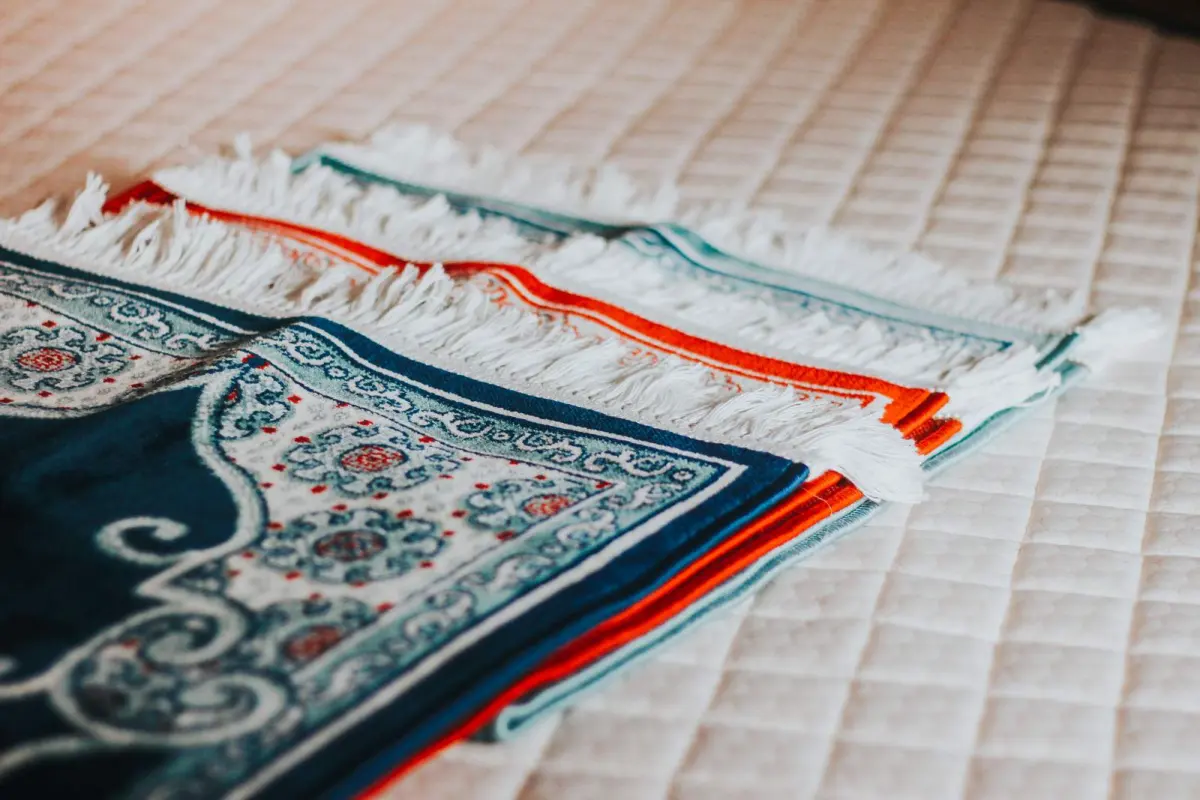
Salah (also written salat) is the ritual prayer that Muslims perform five times every day. It is the second of the five pillars of Islam, right after the declaration of faith, and the first act of worship a new Muslim learns. The Quran describes it simply: “Indeed, prayer has been prescribed for the believers at fixed times” (4:103).
The Arabic word ṣalāh means “connection” or “supplication”. That is exactly how Muslims experience it: five short appointments with God spread across the day, each one taking only a few minutes.
The five daily prayers and their times
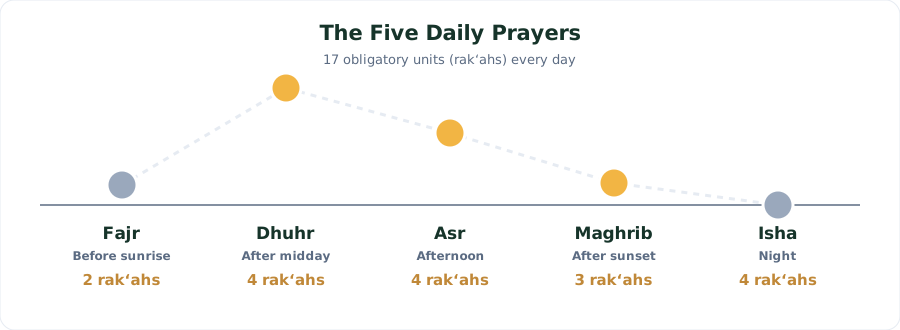
Each prayer has a time window tied to the position of the sun, so the clock time changes with the seasons and your city:
- Fajr — dawn, before sunrise: 2 units (rak‘ahs).
- Dhuhr — just after midday: 4 units.
- Asr — mid-afternoon: 4 units.
- Maghrib — right after sunset: 3 units.
- Isha — night: 4 units.
That makes 17 obligatory units a day. Many Muslims add voluntary (sunnah) prayers around them, but these 17 are the foundation.
The conditions before you pray
A prayer is valid when a few conditions are met: ritual purity through wudu (ablution), a clean body, clothing and place, covering the body appropriately, facing the qibla (the direction of the Kaaba in Makkah), praying within the prayer’s time, and a sincere intention in the heart.
What happens in one unit (rak‘ah)
Every prayer is built from the same unit repeated two, three or four times:
- Takbir: raising the hands and saying “Allahu akbar” (God is the Greatest) to begin.
- Standing (qiyam): reciting Surah al-Fatiha, then another short passage of the Quran.
- Ruku: bowing with a straight back and hands on the knees.
- Rising to stand again.
- Sujood: two prostrations with a short sitting between them.
After the second unit and at the end, the worshipper sits for the tashahhud, and the prayer closes by turning the head to the right and left with the greeting of peace (taslim).
Why the Arabic recitation matters
The words of the prayer — above all al-Fatiha, which is recited in every single unit — are said in Arabic, whatever your mother tongue. For someone who does not speak Arabic this is usually the real obstacle: not the movements, which are learned in a day, but pronouncing seven verses correctly. A few sounds (‘ayn, ḥā’, qāf, ḍād) do not exist in European languages, and reading them from a transliteration often leads to mistakes that change the meaning.
The fastest route we see in practice is short one-to-one sessions where a teacher listens and corrects in real time: most adults recite al-Fatiha accurately within two to four weeks, then add the short surahs used in prayer.
A realistic first week
Begin with what you can do correctly rather than waiting to know everything: learn wudu, learn the movements, and pray the five prayers while you memorise al-Fatiha with a teacher. Prayer is a habit built over a lifetime — the first step is simply to start.