Sujood (سُجود) is prostration: placing the forehead on the ground before God. Every unit of the Muslim prayer contains two prostrations, and it is the posture Muslims regard as the most intimate in all of worship. The Prophet ﷺ said: “The closest a servant comes to his Lord is while he is prostrating, so make plenty of supplication then” (Muslim).
Prostration expresses something words struggle to say: the highest part of the body, the face, is lowered to the floor in humility. For many new Muslims it is the moment the prayer suddenly makes sense.
The seven body parts
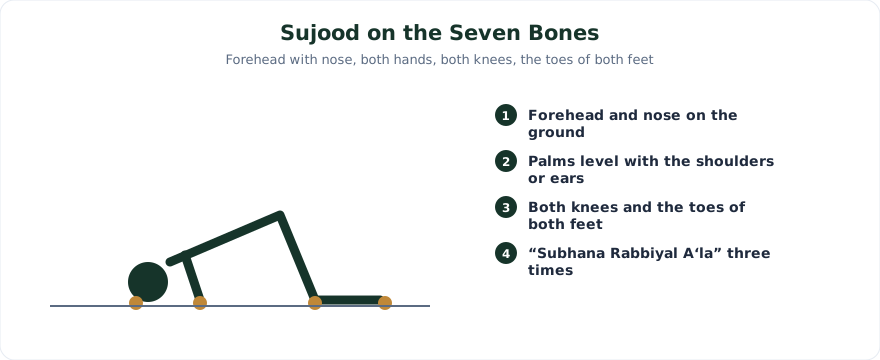
The Prophet ﷺ said: “I have been commanded to prostrate on seven bones” (Bukhari and Muslim). They are:
- The forehead, together with the nose.
- Both hands — palms flat, fingers together and pointing towards the qibla, level with the shoulders or ears.
- Both knees.
- The toes of both feet, bent so they point towards the qibla.
The forearms stay raised off the ground, and men keep their arms slightly away from their sides.
What is said
Going down, the worshipper says “Allahu akbar”. In prostration he repeats “Subḥāna Rabbiya l-A‘lā” — “Glory be to my Lord, the Most High” — at least once, ideally three times. Between the two prostrations he sits briefly and says “Rabbi ghfir lī” (My Lord, forgive me). Personal supplications may also be added in prostration, especially in voluntary prayers.
The four types of sujood
- Prostration of prayer — two in every unit, a pillar of the prayer.
- Prostration of forgetfulness (sujood as-sahw) — two extra prostrations near the end of the prayer when you have added, omitted or doubted something.
- Prostration of recitation (sujood at-tilawah) — a single prostration when reciting or hearing one of the fifteen verses of prostration in the Quran.
- Prostration of gratitude (sujood ash-shukr) — a single prostration on receiving good news or being saved from harm.
Common mistakes
- Lifting the nose or the feet off the ground during prostration.
- Resting the forearms flat on the floor, which the Prophet ﷺ forbade.
- Rushing up before the body is still — stillness (ṭuma’nīnah) is required here as in ruku.
- Skipping the short sitting between the two prostrations.
Why posture and words go together
Sujood joins the body and the tongue: the posture is simple, but the Arabic phrases must be pronounced correctly — “A‘lā” with a clear ‘ayn, not “Ala”. A teacher who can see and hear you corrects both in a single session. That is what our online lessons offer to new Muslims and to children learning to pray: a calm, one-to-one setting where no question is too basic.