Umrah is often called the “lesser pilgrimage”. Like Hajj it takes the believer to the Kaaba in Makkah, but unlike Hajj it can be performed at any time of the year and takes only a few hours. The Quran commands: “Complete the Hajj and the Umrah for God” (2:196). Most scholars consider it a strongly recommended act, and some regard it as obligatory once in a lifetime.
The Prophet ﷺ said: “One Umrah to the next is an expiation for what lies between them” (Bukhari and Muslim), and that an Umrah performed in Ramadan equals a Hajj in reward — though it does not replace the obligatory Hajj.
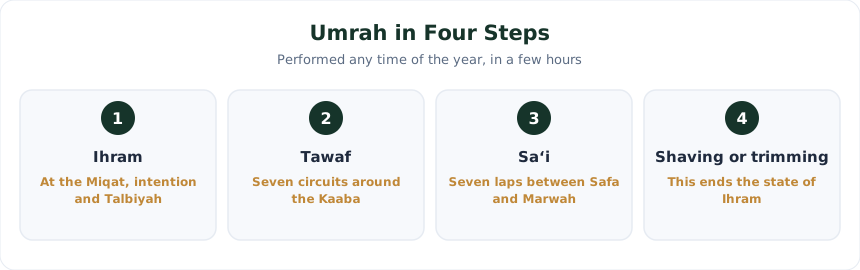
Step 1 — Ihram
Before crossing the boundary station (mīqāt) on the way to Makkah, the pilgrim takes a bath if possible, men put on two plain white cloths, women their ordinary modest clothing, and everyone makes the intention for Umrah. From this moment the pilgrim repeats the Talbiyah: “Labbayka Llāhumma labbayk, labbayka lā sharīka laka labbayk…” — “Here I am, O God, here I am; You have no partner, here I am.”
In Ihram certain things become forbidden: perfume, cutting hair or nails, hunting, and marital relations; men may not wear sewn, fitted clothing or cover their heads.
Step 2 — Tawaf
At the Sacred Mosque the pilgrim walks seven circuits around the Kaaba, counter-clockwise, starting and ending at the corner of the Black Stone, saluting it with the right hand at each pass. Men uncover the right shoulder during this Tawaf and walk briskly in the first three circuits if they can. Afterwards the pilgrim prays two units behind the Station of Ibrahim, or anywhere in the mosque, and drinks from Zamzam water.
Step 3 — Sa‘i
The pilgrim then walks seven laps between the hills of Safa and Marwah, starting at Safa and ending at Marwah — Safa to Marwah counts as one lap, Marwah back to Safa as another. This commemorates Hajar running between the two hills searching for water for her son Isma‘il, until the spring of Zamzam appeared.
Step 4 — Shaving or trimming the hair
Men shave their heads or shorten their hair evenly; women cut a fingertip’s length from the ends. With this the Umrah is complete and the restrictions of Ihram are lifted.
How long it takes
The rites themselves take three to six hours depending on the crowds. Many visitors combine Umrah with a visit to the Prophet’s Mosque in Madinah, which is recommended but is not part of the Umrah.
Arriving prepared
There is no fixed supplication for each circuit; you may ask God in any words. But knowing the Talbiyah, a few authentic supplications and the verses recited at Safa — and understanding them — makes the hours around the Kaaba far more meaningful. Learning them with a teacher before you travel, even over a few short online sessions, is one of the best ways to prepare.