
Wudu is the ritual washing a Muslim performs before prayer. Without it the prayer is not valid, which is why it is usually the very first practical thing a new Muslim learns. It takes two to three minutes, needs only clean water, and can be done at any sink.
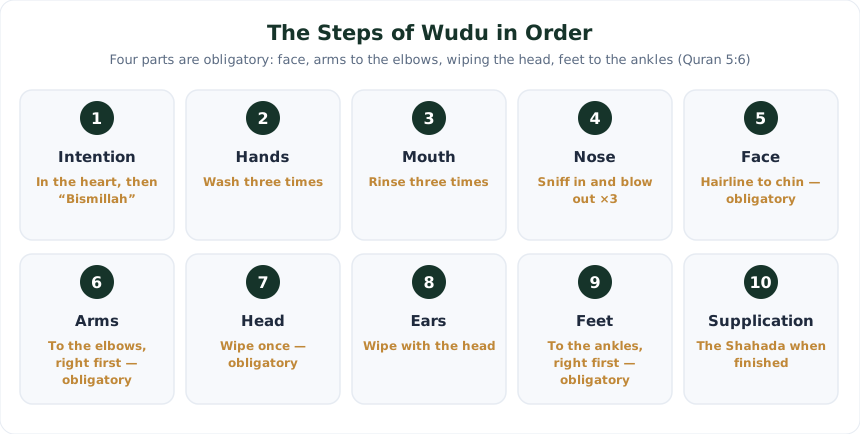
Its basis is a single verse of the Quran: “O you who believe, when you rise to pray, wash your faces and your arms up to the elbows, wipe over your heads, and wash your feet up to the ankles” (5:6).
The four obligatory parts
From that verse scholars derive four parts that must be washed or wiped for wudu to count:
- The face, from the hairline to the chin and from ear to ear.
- The arms, up to and including the elbows.
- Wiping the head with wet hands.
- The feet, up to and including the ankles.
Most schools of law add the intention and keeping the order; the Hanafi school regards these as recommended rather than required. Everything else in the description below follows the practice of the Prophet ﷺ and completes the wudu.
The ten steps in order
- Intention in the heart, then say “Bismillah” (in the name of God).
- Wash the hands up to the wrists three times.
- Rinse the mouth three times.
- Rinse the nose: draw water in and blow it out, three times.
- Wash the face three times.
- Wash the arms up to the elbows, right first, three times each.
- Wipe the head once, from the forehead to the back and back again.
- Wipe the ears, inside with the index fingers and behind with the thumbs.
- Wash the feet up to the ankles, right first, three times each, making sure water reaches between the toes.
- Say the Shahada afterwards: “I bear witness that there is no god but Allah, and that Muhammad is His servant and Messenger.”
Washing each part once is enough; three times is the recommended practice. Water should be used without waste, even at a running tap.
What breaks wudu
Wudu stays valid until something breaks it. The main things agreed upon are: using the toilet (urine or stool), passing wind, deep sleep, and losing consciousness. Some schools add touching the private parts directly or, for some scholars, eating camel meat. After any of these, you perform wudu again before the next prayer — not after every prayer if nothing has broken it.
When there is no water: tayammum
If water is unavailable, or using it would harm you because of illness, Islam provides a dry ablution called tayammum: striking clean earth or a dusty surface lightly with the hands and wiping the face and the hands. It replaces wudu until water becomes available.
Common beginner mistakes
Leaving the elbows or heels dry is the most frequent error; another is rushing so that water never reaches the area between the toes. A good habit is to slow down for the four obligatory parts — they are the ones that make wudu valid.
Wudu prepares the body; the prayer that follows needs Arabic recitation, starting with al-Fatiha. That part is easiest to learn with a teacher who hears you and corrects your pronunciation — which is exactly what our one-to-one online lessons are built for.