Zakat is the obligatory charity that every Muslim with sufficient wealth gives once a year. It is the third pillar of Islam, and the Quran mentions it together with prayer more than twenty-five times: “Establish prayer and give zakat” (2:43). Prayer is the believer’s duty towards God; zakat is the duty towards the people around him.
The Arabic word zakāh means both “purification” and “growth”. The Quran explains: “Take from their wealth a charity by which you purify them and make them grow” (9:103). Giving a small share is understood to purify the rest of one’s money and to bless it.
Who has to pay it
Zakat is due from an adult, sane Muslim whose savings meet two conditions:
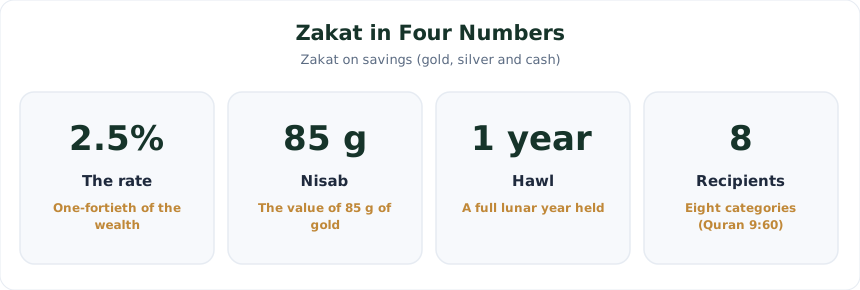
- Nisab — a minimum threshold. For gold, cash and savings, most contemporary scholars use the value of 85 grams of gold; others use the value of 595 grams of silver, which is much lower and therefore benefits the poor more.
- Hawl — the wealth must have stayed at or above the nisab for one full lunar year (about 354 days).
How much: the 2.5% rule
On gold, silver, cash, bank savings and goods held for trade, the rate is one-fortieth, i.e. 2.5%. Agricultural produce and livestock have their own rates (for crops, 10% or 5% depending on irrigation).
A worked example: suppose you have held savings of 12,000 euros for a whole lunar year, and 85 g of gold is worth less than that. Your zakat is 12,000 × 2.5% = 300 euros. If your savings had dropped below the nisab during the year, many scholars would restart the year from the moment it was reached again.
Personal needs are not counted: your home, your car, your clothes and the furniture you use. Debts due soon may be deducted according to many scholars. For complex cases — shares, pensions, business stock, jewellery worn by women (on which scholars differ) — it is wise to ask a qualified scholar.
Who receives zakat
The Quran lists eight categories (9:60):
- The poor and the needy.
- Those employed to collect and distribute zakat.
- Those whose hearts are to be reconciled to Islam.
- Freeing those in bondage.
- People overwhelmed by debt.
- Those striving in the cause of God.
- The stranded traveller.
Zakat may not be given to one’s own parents, children or spouse, since one is already responsible for supporting them.
Zakat al-fitr is something different
At the end of Ramadan, every Muslim — child or adult — gives zakat al-fitr, a small fixed amount of staple food (one ṣā‘, roughly 2.5–3 kg) or, in some schools, its value, paid before the Eid prayer so that the poor can celebrate too. It is separate from annual zakat on wealth.
Understanding the sources
Many people first meet zakat in a translation and have questions the translation cannot answer: what exactly does “nisab” mean, why do the verses use these words? Learning to read the Quran in Arabic, even a little, opens these texts directly — and a qualified teacher can explain the verses on zakat as you read them.